

The role of scripture in modern apparel design is far more nuanced than a printed verse on a cotton tee. Most designers and consumers encounter faith-based apparel and immediately think of bold biblical text across a chest, a cross screenprinted on a hoodie. But that framing misses something deeper. Scripture has always shaped how humans think about the body, clothing, and identity. And the most sophisticated designers working in this space today understand that the influence of scripture on fashion is structural, symbolic, and experiential. It operates beneath the surface, the same way good theology does.
Table of Contents
- Key takeaways
- The historical context of scripture in apparel design
- Modern aesthetic strategies for scripture in apparel
- Consumer behavior and the faith-inspired apparel market
- Practical considerations for scripture-inspired design
- My perspective on scripture and design
- What Human By God builds on this foundation
- FAQ
Key takeaways
| Point | Details |
|---|---|
| Scripture shapes design philosophy | Faith influences silhouette, color, and symbolism, not just printed text on garments. |
| Subtle placement carries more weight | Private scripture inside linings or caps creates personal reflection rather than public performance. |
| Religiosity drives purchasing behavior | Religious commitment strengthens buying decisions in faith-inspired fashion markets significantly. |
| Lived theology is the design goal | Garments can embody doctrine and spiritual identity without a single visible verse. |
| Authenticity over cliché | Avoiding overused Christian phrases produces stronger, more credible faith-based apparel brands. |
The historical context of scripture in apparel design
Clothing has never been neutral in the Christian tradition. The New Testament addresses it directly. 1 Timothy 2:9 teaches modesty and discretion in dress, prioritizing inner character over external display. That single passage has shaped centuries of Christian dress codes, from monastic habits to the restrained silhouettes of colonial Protestant communities. The design choices were theological. Fabric weight, coverage, color sobriety. All of it communicated a doctrine.
By the medieval period, the church was commissioning some of the most technically advanced textiles in the world. Vestments embroidered with gold thread and biblical scenes were garments that functioned as scripture in wearable form. The iconography was precise, and the craftsmanship intentional. These were not decorative choices. They were catechetical ones.

The shift into secular fashion came slowly, then all at once. Mid-century couturiers drew silhouettes from ecclesiastical robes, from the cape to the structured shoulder to the floor-length column. Then, by the late 20th century, the symbolism became explicit and bold. Christian imagery appeared prominently in collections from Versace and Dolce & Gabbana, with Versace’s 1991 biker jackets carrying bejeweled crosses and Dolce & Gabbana’s 1998 “Stromboli” collection integrating Marian figures directly into ready-to-wear.
What those designers were doing was significant. They were not making devotional objects. They were borrowing the visual authority of scripture and religious iconography and placing it in a new context. The effect on the culture was immediate and lasting.
Pro Tip: When researching historical scriptural influences in fashion, study ecclesiastical textile archives, not just runway history. The design intelligence in medieval vestments is as relevant to contemporary apparel as any recent collection.
The key evolution to understand is this:
- Pre-20th century: Scripture shaped dress through doctrine, producing modesty codes, formal silhouettes, and restrained ornamentation.
- Late 20th century: Christian symbols entered fashion as visual language, often divorced from their theological meaning.
- Early 21st century onward: A new generation of designers began reclaiming that meaning, working more carefully with faith-based aesthetics rooted in conviction rather than appropriation.
Modern aesthetic strategies for scripture in apparel
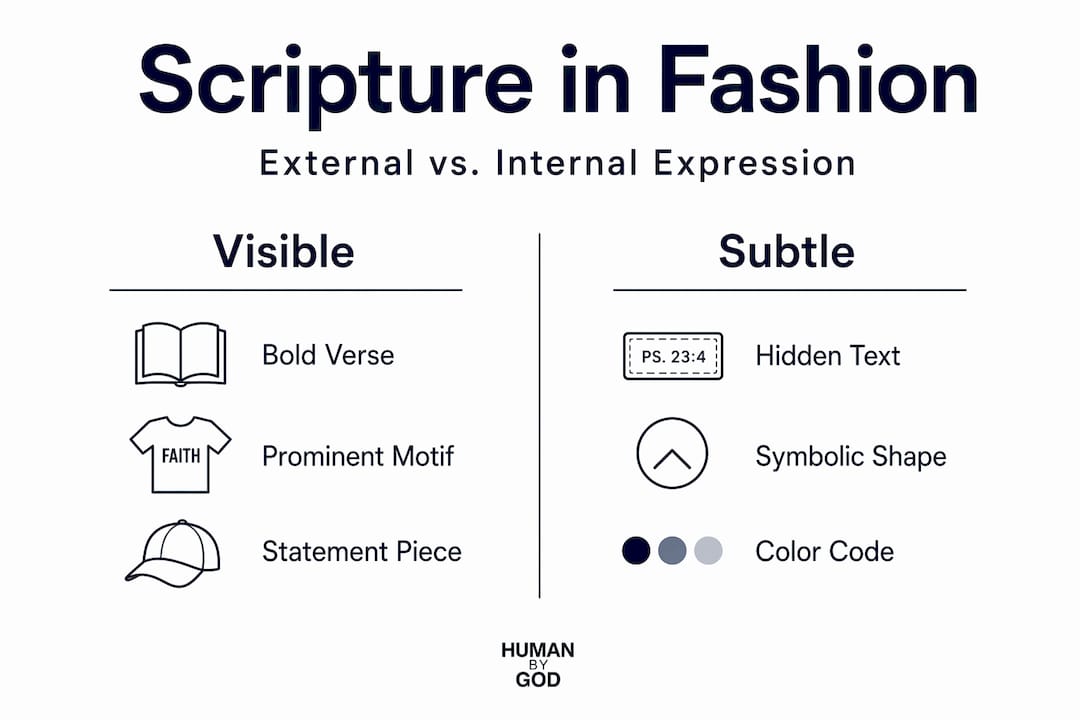
The most interesting thing happening in faith-based apparel design right now is not what you can see. Private scripture placement inside hat crowns, printed on the interior taping of a hoodie, stitched inside a collar. These placements make the message intimate. The wearer knows it is there. The world does not. And that asymmetry creates a very different experience than a verse displayed across a chest.
This shift reflects a broader maturity in how designers are thinking about scriptural influences in fashion. The question is no longer simply “should we include scripture?” It is “where does this text live, who encounters it, and what does that encounter produce?”
| Design approach | Effect on wearer and audience |
|---|---|
| Bold external verse | Public declaration, social signaling, immediate brand legibility |
| Subtle external motif (cross, symbol) | Quiet cultural marker, faith identity without assertion |
| Interior/private scripture placement | Personal reflection trigger, intimate spiritual meaning |
| Silhouette and structure inspired by scripture | Embodied theology without explicit text or symbol |
| Color and material as doctrinal expression | Communicates values through sensory experience alone |
Symbolism, motifs, and color choices carry real theological weight when deployed carefully. Cross-faith semiotic frameworks show that motifs, colors, and textual elements communicate spiritual values through fashion independently of literal text. Applying this thinking means a designer can translate a verse about light into a specific off-white palette, or render the concept of covering into a generous, weighted silhouette.
Heritage is another dimension worth serious attention. Christian ideology influenced dress formality through court fashion silhouettes that communicated religious customs tied to concepts of decorum. That lineage is available to any designer willing to study it. A relaxed, oversized garment can carry the same theological intent as a structured liturgical vestment if the design decisions behind it are grounded in the same values.
Pro Tip: Before adding any scripture text or symbol to a garment, write one sentence describing the spiritual experience you want the wearer to have. Then design toward that sentence. The text and symbols will follow naturally, or prove unnecessary.
The designers who are getting this right are not treating scripture as content to be placed on a product. They are treating garments as lived theology, where every material decision embodies a conviction. That is a fundamentally different design practice. And it produces fundamentally different results.
Consumer behavior and the faith-inspired apparel market
The data here is worth knowing. Religiosity strengthens purchase decisions in faith-inspired and modest fashion markets, with electronic word-of-mouth playing a critical role in converting interest into sales. A 2026 F1000Research study confirmed that religious commitment does not just influence personal values. It actively moderates how consumers respond to marketing and community recommendation.
What this means practically is that community trust is the primary currency in this market. A faith-based apparel brand that earns genuine credibility within its community will outperform a larger brand with better media spend every time. The purchase decision in this space is rarely impulsive. It is considered, and often influenced by someone the buyer already trusts.
There are also meaningful distinctions in how consumers respond to public versus private faith symbolism:
- Consumers who prefer public faith symbolism are typically seeking social connection, community identification, and cultural expression.
- Consumers who prefer private faith symbolism tend to prioritize personal devotion, spiritual intimacy, and quiet conviction.
- Many consumers want both, and the most sophisticated brands serve both within a single garment.
Christian symbolism in fashion has also been recontextualized as a form of personal meaning-making, where individual interpretation matters more than institutional doctrine. This creates both opportunity and responsibility for designers. The audience is not homogeneous. Some wearers will read a motif as purely aesthetic. Others will carry it as a confession of faith. Designing with that range of reception in mind requires intentionality.
Brand authenticity is the factor that most consistently predicts loyalty in this market. When a brand’s scriptural design elements appear genuinely rooted in a theological conviction rather than trend-following, consumers notice. They stay. They tell others.
Practical considerations for scripture-inspired design
If you are a designer working to integrate scripture into contemporary apparel, the most useful reframe is this: treat scripture placement as an experience design problem. Interior scripture placements change the nature of spiritual meaning transmission entirely. The garment becomes a private ritual object as much as a public fashion item.
Here is a practical framework for making those decisions:
- Define the spiritual intent. What scriptural truth or value should the garment embody? Start here, before color, silhouette, or placement decisions are made.
- Choose placement with purpose. External placement communicates to the world. Interior placement communicates to the wearer. Both are valid. Neither is accidental.
- Let silhouette carry theology. Modesty, coverage, and decorum are design values before they are moral ones. A garment’s structure can embody biblical themes in clothing without a word of text.
- Use color and material deliberately. Restrained palettes communicate intentionality. Heavy, quality fabrication signals that the garment is meant to last, and that the values it carries are durable ones.
- Audit for cliché. If a phrase or symbol has appeared on thousands of mass-market Christian products, it has lost its capacity to carry meaning. Find the less-traveled scriptural reference, the unexpected motif, the image that requires a second look.
Pro Tip: Study jewelry design from other faith traditions for unexpected frameworks. The role of jewelry in Muslim identity, for example, offers designers a rigorous model for thinking about how wearable objects carry scriptural meaning and communal belonging simultaneously.
Storytelling matters as much as design execution. A brand whose mission is articulated clearly, and whose design decisions are visibly coherent with that mission, builds trust that no marketing campaign can manufacture. The most credible faith-based apparel brands are the ones where you can trace every design choice back to a conviction.
My perspective on scripture and design
I’ve spent enough time thinking about faith and apparel to have a strong opinion on this: the loudest scripture is rarely the most powerful. The verse printed across the chest reads as a statement. The verse stitched inside the collar reads as a secret. One performs. The other sustains.
What I find genuinely exciting about where this category is heading is the move toward what I’d call doctrinal design, where religious garments embody theology at the level of structure, not just surface. That is a harder design problem. It requires the designer to understand scripture well enough to translate it into a silhouette, a fabrication choice, a color story. It cannot be outsourced.
The challenge I see most often is designers who love the aesthetic of faith-based apparel but haven’t done the theological work. The result is product that looks the part but carries no weight. Consumers who actually live this faith recognize the difference immediately.
Scripture is a design system with thousands of years of material expression behind it. The inspiration from scripture in fashion available to a contemporary designer is vast, largely unexplored, and genuinely original. The designers who go there seriously will make something worth wearing.
— H
What Human By God builds on this foundation
Human By God exists at the precise intersection this article describes. The brand’s design philosophy is rooted in Genesis 1:26, but the execution never shouts it. The Protected in Plain Sight hoodie carries its scriptural conviction in the structure of the design itself, in the weight of the fabric, the restraint of the typography, and the intention behind the name.

The Genesis Cap demonstrates what private scripture placement looks like at its most refined. Faith expressed without performance, identity worn without announcement. These are garments that sit comfortably alongside any premium contemporary brand because the design discipline behind them is identical. The only difference is the source material.
For designers seeking a working model of scripture-inspired design that is reverent, contemporary, and commercially credible, Human By God is worth studying closely.
FAQ
What is the role of scripture in modern apparel design?
Scripture influences modern apparel design through design philosophy, symbolic motifs, silhouette, color, and placement strategy, not just printed biblical text. It shapes how designers think about the body, identity, and the wearer’s experience.
How do designers use biblical themes without printing verses on garments?
Designers translate biblical themes in clothing through silhouette choices, restrained color palettes, interior scripture placement, and motifs that carry theological meaning without explicit text. The garment embodies the value rather than announcing it.
Does faith-based apparel perform well commercially?
Yes. Research shows that religious commitment strengthens purchase intent in faith-inspired markets, and that community-driven word-of-mouth is a critical driver of conversion and brand loyalty.
What is subtle faith design in modern Christian streetwear?
Subtle faith design refers to apparel that communicates spiritual identity through restrained aesthetics, private scripture placement, and structural design choices rather than overt religious text or imagery. The wearer knows. The world infers.
How can designers avoid clichés in scripture-inspired apparel?
Audit every phrase and symbol against what already exists in mass-market Christian apparel. If it is overused, it has lost its capacity to carry meaning. Go deeper into scripture for less familiar references, and let design decisions speak where words would be redundant.