

Most people assume faith-based apparel is about broadcasting religion. A cross on a shirt. A fish on a hat. Something unmistakably church. But why Christians wear faith-based apparel runs deeper than that, and the most meaningful examples of it look nothing like what you’d expect. Today’s faith-inspired clothing choices are quieter, more personal, and more intentional. They sit at the intersection of identity, conversation, and daily spiritual practice. This article unpacks what actually drives those choices.
Table of Contents
- Key takeaways
- Why Christians wear faith-based apparel in today’s culture
- The real motivations behind faith-inspired clothing choices
- Faith apparel as a tool for real conversation
- Choosing faith-based apparel that fits your convictions
- My honest take on faith apparel as a spiritual act
- Wear something that means something
- FAQ
Key takeaways
| Point | Details |
|---|---|
| Identity over announcement | Most Christians wear faith-based clothing to reinforce their own sense of who they are, not to broadcast a message at others. |
| Subtlety is intentional | Younger believers increasingly prefer clothing with understated faith references that integrate naturally into everyday style. |
| Apparel opens conversations | Well-designed faith clothing can spark genuine dialogue about belief without feeling confrontational or performative. |
| Quality signals conviction | Clothing that looks and feels premium communicates that faith is worth taking seriously in every area of life. |
| Reflection before purchase | Choosing faith-based apparel thoughtfully, with attention to message and context, turns a simple act into a meaningful one. |
Why Christians wear faith-based apparel in today’s culture
Faith in America is not disappearing. It is shifting. 47% of Americans say religion is “very important” to them in 2025, even as weekly church attendance has declined. That gap between personal conviction and communal practice tells you something important. People still want their faith to show up in daily life. They just want it to show up differently.
Clothing is one of the most natural places for that to happen. Mentioned over 100 times in the Bible as symbolic of God’s mercy and care, the act of getting dressed has deep theological roots. In Genesis, God himself clothed Adam and Eve. In Colossians, Paul instructs believers to “clothe yourselves with compassion, kindness, humility.” Getting dressed is never purely practical in Scripture. It carries meaning.
“Dressing with intention invites the Holy Spirit into daily life, transforming clothing from a mundane act to a Christian witness and reminder of baptismal identity.”
For millennial and Gen Z Christians especially, the importance of faith-based clothing has evolved. Overt slogans and neon graphics feel like performance. What resonates now is clothing that reflects conviction without demanding attention. Younger Christian generations actively seek authentic, non-confrontational ways to express faith, making subtle and stylish apparel far more appealing than anything that shouts.
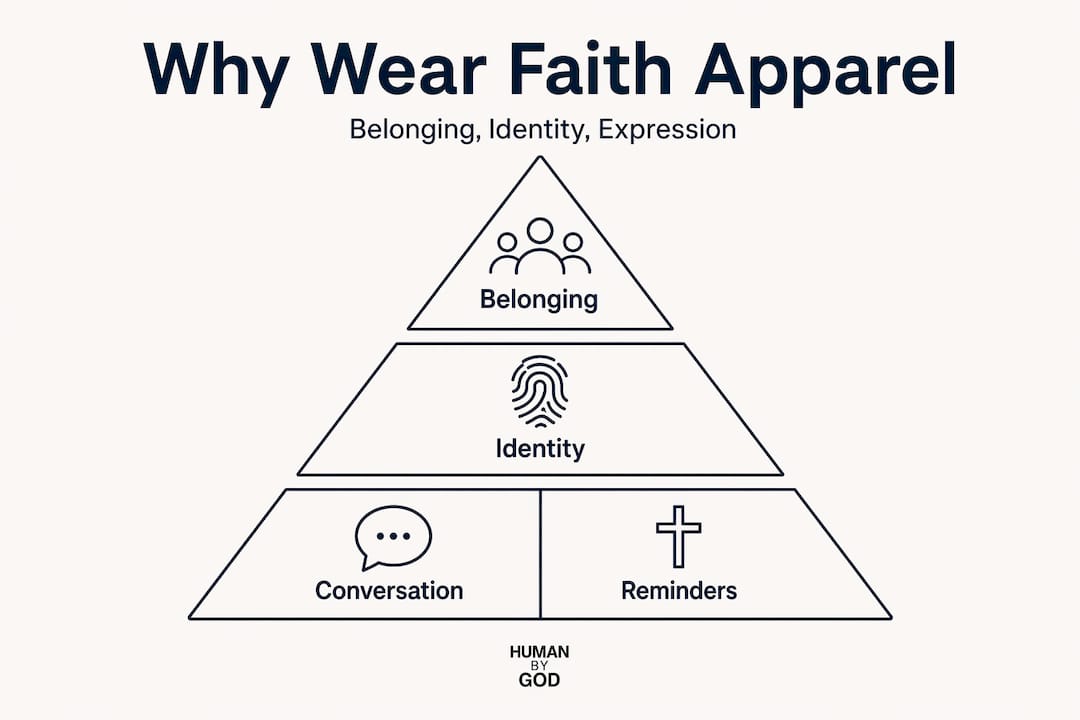
Faith-based apparel also answers a need for belonging. When you wear something that reflects your values, you signal to others who share those values. That signal doesn’t require words. It creates a kind of quiet recognition, a sense that you are seen by people who understand what the clothing means.
The real motivations behind faith-inspired clothing choices
The reasons for Christian apparel are more layered than most people acknowledge. They include personal, communal, and spiritual dimensions that often overlap in a single garment.
Here is what actually drives people toward faith-based clothing:
- Identity reinforcement. Many Christians use apparel not as performance but as “posture,” a daily reminder of who they are and whose they are. Wearing something with a Scripture reference or a quietly theological phrase anchors the day before it starts.
- Conversation without confrontation. A well-designed piece of faith clothing opens doors that a direct approach often closes. It gives curious people a low-pressure entry point.
- Cultural integration. Wearing faith-based clothing that looks like it belongs in any wardrobe lets believers move through secular spaces without the social friction that overtly religious symbols sometimes create.
- Spiritual practice. For some, the act of choosing what to wear becomes a moment of reflection. It is a small but real extension of spiritual discipline into ordinary life.
- Community and belonging. Within a church or faith community, wearing shared visual language builds connection. It is the same instinct that makes sports fans wear team colors.
The spiritual significance of clothing is also tied to modesty, though not in the way people often frame it. Biblical modesty focuses on humility and stewardship rather than rules about hemlines. That reframing matters. It means clothing choices become about reflecting character, not conforming to a dress code. That is a much more interesting and personal reason to get dressed intentionally.
Some believers go further, connecting their wardrobe to the liturgical calendar. Liturgical style uses colors and textures that mirror the church seasons, offering subtle faith expression without a single overt symbol. Wearing deep purple during Advent or muted tones during Lent becomes a private act of attentiveness. The person next to you at the coffee shop sees nothing unusual. You know exactly what it means.

Pro Tip: If you are new to faith-inspired clothing choices, start with one piece that carries a phrase or reference that genuinely resonates with you. Wear it in a context where you feel comfortable before working it into your full rotation. The goal is authenticity, not display.
Faith apparel as a tool for real conversation
There is a difference between wearing a shirt that says something and wearing a shirt that starts something. The best faith apparel does the latter.
72% of religious audio listeners say content aligns with their personal views, which reflects a broader truth: people are more open to faith conversations than the cultural noise suggests. The barrier is usually the entry point, not the willingness. Good clothing removes that barrier.
Here is how thoughtful Christians use apparel to open conversations without preaching:
- Wear pieces with phrases that invite curiosity, not declaration. Something like “Always Seen. Always Covered.” prompts a question. “I’m a Christian” closes one.
- Be prepared to explain what your clothing means to you personally. The most compelling conversations start with genuine personal reflection, not rehearsed talking points.
- Use prepared conversation prompts. Conversation-starter cards paired with faith apparel help wearers move from a noticed garment to an authentic discussion naturally. Some brands include these with purchases.
- Match the context. The piece you wear to a gym works differently than what you wear to a work meeting. Christian fashion statements land better when they fit the setting.
- Let quality do some of the work. When clothing looks genuinely premium, people engage with it differently. They ask where it is from. That question is its own opening.
The benefits of religious apparel in the context of evangelism are not about making a scene. They are about making a connection. Successful faith-based brands understand this. They design pieces that empower wearers to share faith naturally, without forcing a moment that doesn’t exist.
Pro Tip: Before wearing a faith piece somewhere new, think through one or two honest sentences about what the message means to you. Not a script. Just clarity. You’ll feel more confident if someone asks.
Choosing faith-based apparel that fits your convictions
Not all faith-based apparel is created equal, and the difference matters more than people admit. Choosing well means thinking about more than aesthetics.
| What to evaluate | What to look for |
|---|---|
| Message integrity | Does the phrase or symbol reflect something you actually believe, or is it just familiar? |
| Design quality | Would you wear this if it had no faith reference? If yes, the design is doing real work. |
| Brand alignment | Does the brand’s ethos match your values, or is faith just a marketing angle? |
| Wearability | Does it work in your actual daily contexts, not just at church or faith events? |
| Durability | Is the quality worth the price? Premium materials communicate that faith deserves care. |
A few principles worth keeping in mind:
- Start with intention. Before buying, ask what you want the piece to do. Personal reminder. Conversation starter. Community signal. Each one points you toward different designs.
- Prioritize pieces that feel like you. Faith clothing works best when it doesn’t feel like a costume. If it fits your usual style, you will wear it more and wear it better.
- Look at what the brand actually stands for. A brand built around a genuine theological conviction carries that in the product. You can usually tell. A brand that uses faith as a hook feels hollow in comparison.
- Consider meaningful gift potential. Thoughtfully chosen faith apparel makes a genuinely resonant gift for someone in your community.
The faith hoodie is worth reconsidering on its own terms. When designed with restraint and built with quality, it becomes something a person reaches for every day. That kind of everyday presence is exactly what faith-inspired clothing should aspire to.
My honest take on faith apparel as a spiritual act
I’ve watched the faith apparel space for a long time, and the thing that strikes me most is how rarely people talk about it as a practice. Not a product category. A practice.
There is something real that happens when you get dressed with intention. Not every morning. Not in some perfectly disciplined way. But on the days when you pause and think about what you put on your body, and why, the act quietly shapes the rest of the day. I’ve experienced that. I think most people who wear faith-based clothing honestly have, even if they wouldn’t use those words to describe it.
What I’ve found troubling is when apparel becomes performance. When the goal shifts from “this reminds me of who I am” to “this shows others who I want them to think I am,” the clothing loses its weight. It becomes costume. I’ve seen that happen with individuals and with entire brands, and it is not hard to spot once you know what you’re looking for.
The brands that get it right are the ones that seem almost uninterested in convincing you of anything. They just make something honest and let it speak. That restraint is harder than it looks.
My view is that why you wear Christian shirts matters as much as which ones you wear. The conviction behind the clothing is what gives it presence. Without that, it’s just a graphic on cotton.
— H
Wear something that means something

Human By God was built around one idea: humans are made in the image of God. Every piece the brand produces starts there, not with a slogan, but with a conviction. The result is clothing that sits easily in any context, a morning walk, a work call, a Sunday gathering, because it was designed for ordinary life, not just sacred spaces.
The embroidered hoodies carry that quiet theological weight without announcing it. The Genesis Cap does the same for everyday wear. These are pieces built to last, designed to prompt questions, and grounded in Scripture in a way that feels modern rather than dated. If you are looking for faith-inspired clothing that reflects who you are without making a scene, Human By God is worth exploring.
FAQ
Why do Christians wear faith-based apparel instead of just living their faith?
Wearing faith-based apparel is not a substitute for living faith. It functions as a daily reminder of personal identity and opens natural opportunities for conversation in everyday spaces.
Does faith-based clothing have to include crosses or Bible verses?
No. Much of the most meaningful faith-based clothing uses phrases, colors, or design language rooted in Scripture without displaying traditional religious symbols. The spiritual significance of clothing lies in the intention behind it.
What makes some Christian apparel feel authentic and others feel like marketing?
Authentic faith apparel comes from brands with a genuine theological foundation, where the design reflects real conviction rather than using faith as a style trend or demographic hook.
Can faith-based apparel actually start real conversations about belief?
Yes. Conversation-starter cards paired with thoughtfully designed apparel help wearers move naturally from a noticed piece of clothing to an honest discussion about their faith.
How should younger Christians think about wearing faith-based apparel in secular spaces?
The most effective approach is choosing pieces with understated messaging that fits naturally into your existing style. Subtle, stylish faith apparel allows believers to express conviction without creating social friction in non-faith environments.