

Something quiet happened to the Sunday morning wardrobe. The pressed slacks, the modest skirt suit, the shoes saved specifically for the pew — they started disappearing. Understanding why faith apparel replaced church clothes is less about fashion trends and more about a generation rethinking what it means to carry faith into every room, not just the sanctuary. This shift touches culture, theology, and identity in ways that go deeper than hemlines or hoodie fabric. And it is worth paying attention to.
Table of Contents
- Key takeaways
- Why faith apparel replaced church clothes
- What Scripture actually says about clothing
- The rise of faith-based streetwear
- Cultural and social implications of the shift
- My take on what this shift really means
- Wear your faith every day with Human By God
- FAQ
Key takeaways
| Point | Details |
|---|---|
| Church dress codes have roots in reverence | Formal attire historically signaled respect for worship, but it also created social barriers and performance pressure. |
| Scripture prioritizes heart over hemline | Biblical teaching centers modesty and humility, not prescribed styles or formal fashion. |
| Faith apparel functions as a daily uniform | Modern believers are choosing minimalist, scripture-rooted clothing that integrates faith into every context, not just Sunday. |
| The shift is cultural and theological | Changing church dress codes reflect a broader desire for authenticity over performance in spiritual life. |
| Quality and intentionality matter | Faith-based fashion succeeds when it pairs meaningful design with the kind of quality that works at the gym, the office, and everywhere between. |
Why faith apparel replaced church clothes
For most of the twentieth century, getting dressed for church was a ritual inside the ritual. You wore your best because you were going somewhere that deserved your best. That instinct was not entirely wrong. The desire to honor God through intentional preparation, including how you showed up physically, came from a real place of reverence.
But the tradition carried social weight that grew complicated over time. What started as personal devotion calcified into community expectation. Dressing up for church became, for many congregations, a measure of sacredness and belonging. The right outfit signaled membership. The wrong one could make a visitor feel unwelcome before a single word of Scripture was read.
The limitations of that system became clearer with each passing decade:
- New visitors felt judged before they felt welcomed.
- Low-income families experienced quiet shame when their best did not match the congregation’s standard.
- Young people raised in those churches began to feel that faith was something they put on and took off with their Sunday clothes.
- The compartmentalization of faith into a specific dress code made belief feel like a performance, not a way of life.
The cultural shift away from rigid dress codes was already underway in broader society, and churches were not immune. Dress expectations have shifted even for traditionally formal occasions like christenings, reflecting a broader move toward comfort and authenticity over performance. The church clothes tradition did not collapse. It simply could no longer hold the weight people had placed on it.
What Scripture actually says about clothing
Theology moves slower than culture, but it has something clear to say here. The biblical narrative of clothing begins in Genesis 3, where God himself covers Adam and Eve after the Fall. Clothing, from its origin in Scripture, is about covering shame, not performing status.
“Do not let your adorning be external — the braiding of hair and the putting on of gold jewelry, or the clothing you wear — but let your adorning be the hidden person of the heart.” — 1 Peter 3:3-4
The consistent biblical thread is not about hemlines or formality. It is about the inner person. Scripture emphasizes modesty and humility as the governing principles of dress, not particular styles or cultural conventions. There is no divinely mandated dress code for corporate worship. There never was.
This matters because it opens space for something the older dress code tradition often closed off. Biblical teaching allows for cultural adaptation in clothing styles while holding core principles of modesty and humility constant. A believer in Lagos and a believer in Portland do not need to dress alike. The covering is the point. The material expression of that covering can flex with culture, climate, and context.
What cannot flex is the internal posture. A $400 suit worn to impress the congregation carries less spiritual weight than a simple, clean outfit worn with a humble, attentive heart. The external and the internal are not unrelated, but Scripture places the primary emphasis firmly on the latter. Formal church attire was never the problem. Making it a requirement was.
The rise of faith-based streetwear
Something specific replaced the church clothes tradition. It was not athleisure. It was not merely casual dress. It was a category of clothing built with intention — premium fabrics and minimalist designs serving as a daily uniform that integrates faith into life rather than cordoning it off to Sunday mornings.

The appeal is not hard to understand. A generation shaped by brands like Fear of God Essentials and Honor The Gift already understood clothing as identity. Faith-based streetwear entered that same cultural space, but with a different foundation. The message embedded in the fabric was not about aesthetics or status. It was about who made you and who watches over you.
Pro Tip: When evaluating faith apparel brands, look past the graphic and read the founding premise. The brands with staying power are built around a theological idea, not a slogan.
The contrast with traditional church clothes is worth mapping clearly:
| Church clothes | Faith apparel |
|---|---|
| Reserved for Sunday worship | Worn at the gym, office, and on the street |
| Signals compliance with community norms | Expresses personal identity in Christ |
| Formality as the governing aesthetic | Quality and restraint as the governing aesthetic |
| Removed after service | Functions as a daily uniform |
| Often associated with performance | Associated with authenticity |
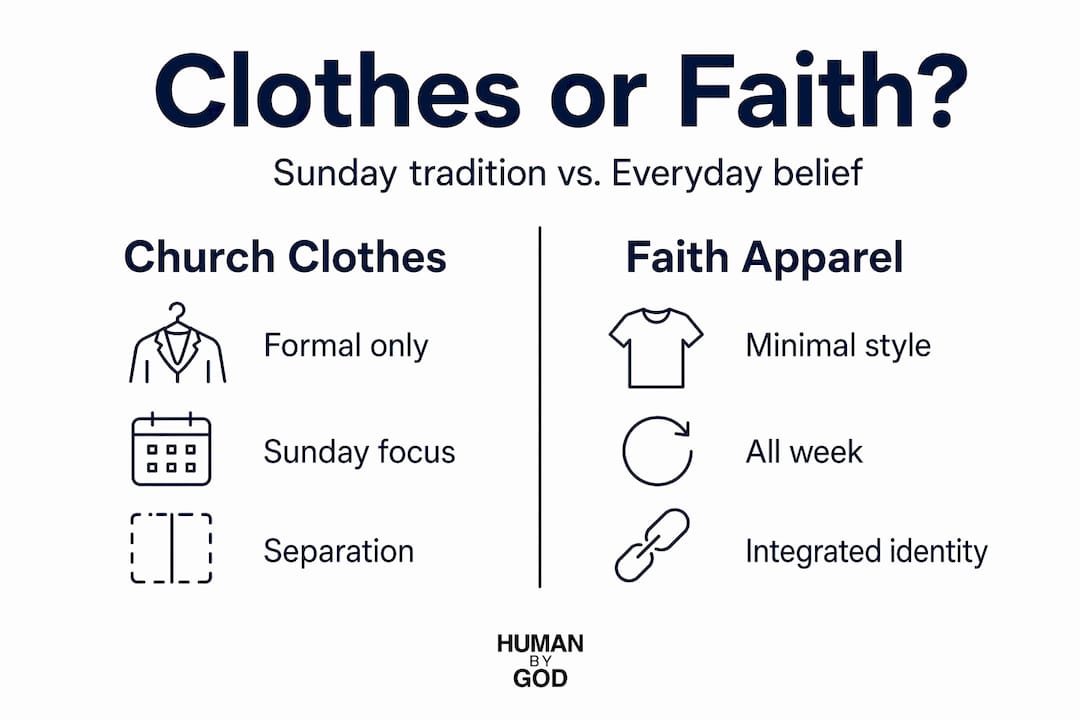
Minimalism in faith apparel reduces decision fatigue and integrates belief into all of daily life rather than isolating it to a single morning a week. And when scripture-inspired clothing pairs with modern design, it creates something a dress code never could: a wearable reminder that travels with you.
Human By God was built on exactly this logic. The brand centers on Genesis 1:26, the idea that humans bear the image of God, and expresses that through quiet typography on hoodies, caps, and tees designed to be worn anywhere. The Protected in Plain Sight hoodie is a straightforward example. It carries theological weight without announcing itself loudly. That restraint is the point.
Cultural and social implications of the shift
The move from church clothes to faith-based fashion carries real consequences for how communities form and how faith gets expressed across generations. Some of those consequences are still unfolding.
The most immediate change is in the culture of church itself. When the dress code relaxes, the implicit gatekeeping relaxes with it. Someone walking in off the street in joggers and a clean tee is no longer quietly categorized before they find a seat. That matters more than most formal traditions acknowledged. Judging worthiness by clothing contradicts the direct teaching of Jesus, who consistently redirected attention away from external markers of righteousness.
Several other shifts are worth naming:
- Faith becomes portable. When your hoodie carries a scriptural reference, your faith is not confined to a building or a dress code. It goes where you go.
- Identity becomes consistent. Young Christians no longer have to switch registers between their Saturday self and their Sunday self. The same clothing works for both, and that continuity matters for spiritual formation.
- Streetwear culture gets reoriented. The generational language of quality, aesthetics, and brand identity gets aimed at something with deeper roots than trend cycles.
- The ‘faith-based’ label signals intentionality. Faith apparel that works across multiple settings, from casual to professional, demonstrates that belief is not a compartment. It is a framework for all of life.
Parents navigating this with their kids have an opportunity that the old dress code tradition rarely offered. When a teenager chooses a faith-branded hoodie to wear to school, that is a declaration made in their own cultural language. It carries more personal investment than a button-down shirt their parents laid out for Sunday.
The changing church dress codes are not a loosening of conviction. They are a recalibration of where conviction gets expressed.
My take on what this shift really means
I’ve thought about this for a long time, and my honest view is that the clothing shift is a symptom of something much healthier than it first appears.
What I’ve observed is that the generation pushing back against formal church attire is not pushing back against reverence. They are pushing back against the version of reverence that had become more about social performance than actual worship. And that distinction is worth defending.
Scripture is clear that a culture of rigid dress codes risks undermining the gospel’s focus on inward faith rather than outward appearance. I believe that. I also believe that clothing is not morally neutral. What you choose to wear does communicate something about who you are and what you value. The question is whether it communicates the right things.
What I’ve found is that the best faith apparel does what good design always does. It removes friction. It removes the performance layer so that what remains is genuine. You wear it because it means something to you, not because someone else expects it. That shift from obligation to identity is a spiritual one, not just a fashion one.
Clothing can divide a community when it becomes a code that separates insiders from outsiders. It can also hold a community together when it reflects a shared conviction worn with humility. The goal is always the second.
— H
Wear your faith every day with Human By God
Human By God was designed for exactly the kind of faith expression this article describes. Not performance. Not compliance. Just quiet, consistent identity rooted in the idea that you are made in God’s image and that truth goes with you everywhere.

The Watched Over. Built Different. hoodie and the Genesis cap are built for daily wear — designed with the same restrained aesthetic as any premium contemporary brand, anchored in Scripture. No slogans. No clichés. Just clean, intentional clothing that carries weight without announcing it. If you are done with the Sunday-only version of your faith, these pieces are made for you.
FAQ
Why did young Christians stop wearing traditional church clothes?
Young Christians moved away from formal church attire because it created a separation between Sunday faith and everyday life. Faith-based streetwear allows belief to be expressed consistently across all settings, not just in the pew.
Is casual church clothing disrespectful to God?
Scripture places the emphasis on the condition of the heart, not the formality of the outfit. Modesty and humility are the biblical standards for dress, and those principles do not require a specific clothing style.
What makes faith apparel different from regular casual wear?
Faith apparel is designed with intentional scriptural meaning built into the aesthetic. The best pieces carry theological weight through restrained typography and meaningful phrases rather than loud graphics or generic slogans.
Can faith-based fashion be worn outside of church?
That is precisely the point. Successful faith apparel is designed for the gym, office, and street, not just Sunday morning. Its versatility is what makes it a daily expression of identity rather than a once-a-week costume.
Does the shift away from church dress codes weaken Christian community?
The evidence suggests the opposite. Removing appearance-based gatekeeping tends to make communities more accessible and more focused on shared conviction rather than shared wardrobe standards.