

Genesis 1:26 defines humanity as the only creation made in God’s image and likeness, a declaration that carries more theological weight than any other verse in the Genesis creation narrative. The Hebrew terms tselem and demuth together mean humans are not merely God’s creations but His true representatives on earth. For young Christians seeking a genesis 1:26 meaning wearable that goes beyond surface-level spirituality, this verse is the most substantive foundation available. It speaks to identity, vocation, and dignity without requiring a single cliché. Human By God was built on exactly this idea: that what you wear can quietly carry the weight of who you are.
What do “image” and “likeness” mean in Genesis 1:26?
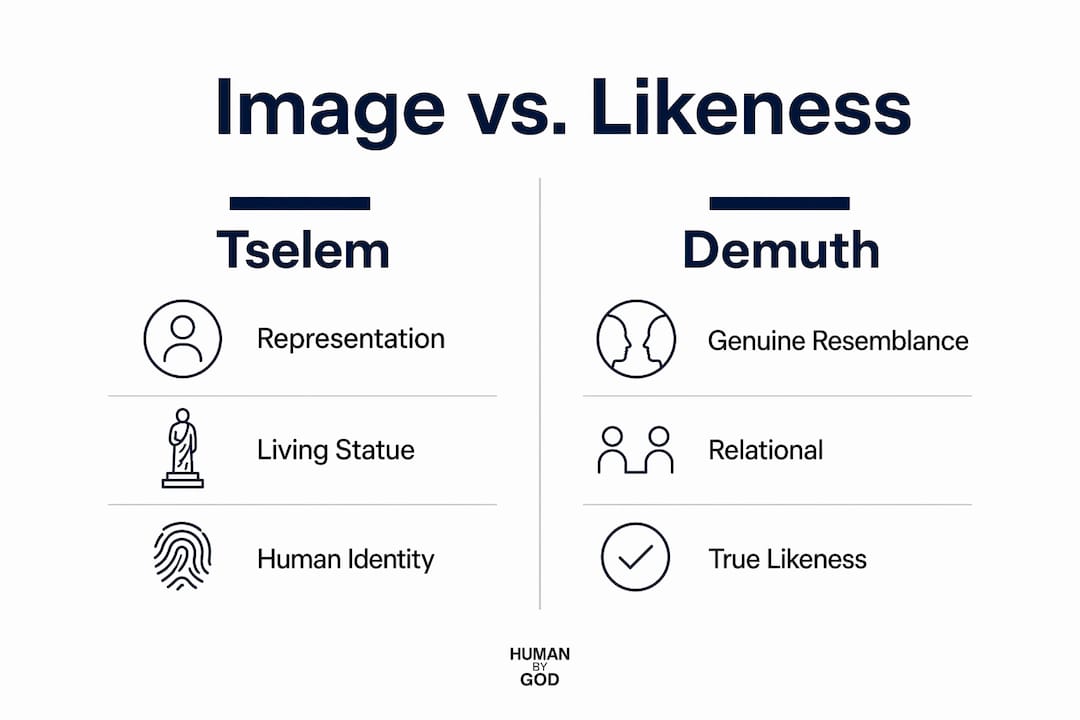
The two Hebrew words at the center of this verse are tselem and demuth, and they are not synonyms. Tselem relates to representation; demuth to genuine resemblance. Together, they form a complementary pair that says something precise: humans are not rough approximations of God, but His actual representatives in the created world. This distinction matters enormously for how you understand your own identity.
Ancient interpreters often read tselem in physical terms, as if God had a body and humans were shaped after it. Modern scholarship has moved well past that reading. The stronger interpretive tradition, supported by the broader context of Genesis 1, reads tselem as a functional term. In the ancient Near East, kings would place statues of themselves in territories they ruled to signal their presence and authority. Humans, in this reading, are God’s living statues placed in creation.

Demuth adds a relational layer. It signals genuine likeness, not just symbolic representation. Humans do not merely stand in for God; they actually resemble His character. This is why the verse carries such weight for identity. You are not a copy. You are a reflection.
| Term | Meaning | Implication |
|---|---|---|
| Tselem (image) | Representation, a living statue of God | Humans carry God’s authority as His delegates |
| Demuth (likeness) | Genuine resemblance, true reflection | Humans reflect God’s actual character, not just His role |
Pro Tip: When choosing wearable scripture designs rooted in Genesis 1:26, look for pieces that communicate representation and dignity rather than just printing the verse reference. The theology is richer than the citation.
How does Genesis 1:26 connect to human vocation and stewardship?
The verse does not stop at identity. It immediately moves to commission: “let them have dominion.” This is not a license for exploitation. Dominion is delegated stewardship reflecting God’s wise and compassionate rule, not autonomous power over creation. The image of God is inseparable from the calling to act like God in the world.
Scholars describe this as the functional or vocational interpretation of the imago Dei. Kirk E. Miller and Richard Middleton both highlight that the image of God is less about what humans are made of and more about what humans are made for. The calling to govern creation is a calling to represent God’s character faithfully, with care, wisdom, and accountability.
This has real implications for how faith wearables communicate meaning. A piece of apparel rooted in Genesis 1:26 is not just a statement about personal identity. It is a statement about responsibility. The wearer is not simply declaring “I am made in God’s image.” They are implicitly claiming the vocation that comes with it.
What that vocation looks like in practice:
- Caring for creation rather than consuming it without thought
- Exercising authority with humility, not dominance
- Reflecting God’s character in relationships, work, and daily decisions
- Treating other image-bearers with the dignity the verse demands
“Dominion is not ownership. It is stewardship on behalf of the one who actually owns everything.” — Genesis 1:26 read through the lens of ancient Near Eastern kingship theology
This framing transforms what it means to wear a Genesis 1:26 reference. The apparel becomes a quiet commitment, not just a declaration.
Why should wearables emphasize dignity over narrow doctrine?
Genesis 1:27 extends the image of God explicitly to both male and female, making the verse’s reach universal. Both genders equally bear God’s image, which means any wearable design rooted in this text carries an inherently inclusive message. That universality is one of the verse’s greatest strengths as a foundation for faith apparel.
The plural pronouns “Us” and “Our” in Genesis 1:26 introduce a separate interpretive question. Scholars interpret “Us” variously as Trinitarian language, a divine council, or a literary plural of majesty. No single interpretation commands universal agreement. Wearable designs that lean too heavily on one reading risk alienating Christians who hold a different view. The safer and more theologically honest approach is to let the design speak to the outcomes the verse clearly establishes: dignity, representation, and vocation.
Genesis 1:26 also does not fully define what the image of God consists of. Communicating broad themes of purpose, dignity, and relationship is more effective for young audiences than narrowly doctrinal claims. This is not theological compromise. It is theological honesty.
Four design principles that follow from this:
- Ground the visual language in dignity and representation, not in specific doctrinal symbols that divide.
- Avoid imagery that implies hierarchy between genders or groups, since the verse explicitly rejects that reading.
- Leave the “Us/Our” question open in design. Focus on what the verse clearly communicates about humanity.
- Use typography and form that feel universal, not tribal. The image of God belongs to everyone the verse addresses.
Pro Tip: The most resonant faith wearables for young Christians tend to communicate a posture rather than a position. “Made in His image” lands differently than a theological diagram. Restraint is not vagueness. It is precision.
How can Genesis 1:26 inspire meaningful wearable faith art?
The spiritual significance of Genesis 1:26 gives designers and wearers a richer vocabulary than most scripture-based apparel currently uses. The verse contains at least three distinct themes that translate directly into visual and typographic language: representation, vocation, and dignity. Each one opens a different design direction.
Representation suggests imagery of reflection, presence, and witness. A wearer carrying this theme is not announcing a belief system. They are embodying one. Scripture typography apparel that uses restrained, color-coordinated lettering communicates this without noise. The message is there for those who look, and invisible to those who do not. That is the point.
Vocation suggests imagery of care, craft, and purpose. Apparel rooted in this theme speaks to the wearer’s sense of calling, not just their identity. It is the difference between a piece that says “I believe this” and one that says “I live by this.” For a generation that wants faith to be integrated into everyday life rather than compartmentalized to Sunday, that distinction matters.
Dignity is perhaps the most powerful theme for wearable faith accessories because it requires no explanation. A hoodie or cap that carries the weight of Genesis 1:26 without spelling it out communicates something the wearer already knows and the observer can sense. Human By God’s approach to this is worth noting: quiet typography, no slogans, no exclamation points. The design trusts the theology.
| Design Theme | Visual Direction | What It Communicates |
|---|---|---|
| Representation | Minimal text, reflective motifs | “I carry God’s presence in the world” |
| Vocation | Purposeful forms, craft-forward materials | “I am made for something specific” |
| Dignity | Restrained color, premium construction | “Every person here bears the same image” |
What to avoid is equally clear. Designs that reduce Genesis 1:26 to a motivational slogan miss the verse’s depth. Apparel that leans on gold crosses, angel wings, or stock religious iconography communicates a cultural affiliation rather than a theological conviction. Faith apparel performs best when it roots itself in vocation and dignity rather than isolated traits or decorative religiosity.
The role of apparel in faith identity is not incidental. What you choose to wear is a form of self-narration. For young Christians who want that narration to be honest, grounded, and free of cliché, Genesis 1:26 offers a foundation that is both ancient and completely current.
Key takeaways
Genesis 1:26 grounds human identity in representation and vocation, making it the most theologically substantive foundation for wearable faith expression available to young Christians today.
| Point | Details |
|---|---|
| Tselem and demuth are distinct | Image means representation; likeness means genuine resemblance. Together they define humans as God’s living delegates. |
| Dominion means stewardship | The commission to “have dominion” is delegated authority, not personal power. Wearables should reflect care, not control. |
| Universal dignity is the safest anchor | Genesis 1:27 includes all genders equally. Designs rooted in shared dignity reach the widest audience without theological compromise. |
| Avoid narrow doctrinal symbols | The “Us/Our” question remains open. Wearables focused on dignity and vocation communicate more honestly than those tied to one interpretation. |
| Restraint is a design virtue | The most effective faith wearables trust the theology. Minimal typography and premium construction carry more weight than loud religious motifs. |
What I’ve learned from wearing this verse
I have watched a lot of faith apparel come and go, and most of it fails the same way. It tries too hard. It announces rather than embodies. It treats the wearer as a billboard rather than a person. Genesis 1:26 is different from most scripture used in apparel because it does not describe a feeling or a promise. It describes a status. You are made in God’s image. That is a fact about your nature, not a sentiment about your day.
What strikes me about young Christians today is that they are not looking for louder faith expression. They are looking for truer faith expression. The Gen Z and millennial Christians I observe want their faith to show up in the quality of what they wear, the restraint of how they carry themselves, and the depth of what they can point to when someone asks. A hoodie that quietly references Genesis 1:26 does more work than a shirt that screams a slogan, because it invites a conversation rather than closing one.
The challenge for anyone designing or choosing wearable scripture art is to resist the temptation to over-explain. The verse does not need your help. It has been carrying its own weight for thousands of years. Your job, as a wearer or a designer, is to get out of the way and let it speak. Human By God understands this. The brand’s entire aesthetic is built on the idea that the most powerful statement is the one that does not need to shout.
— H
Wear the verse, not just the reference
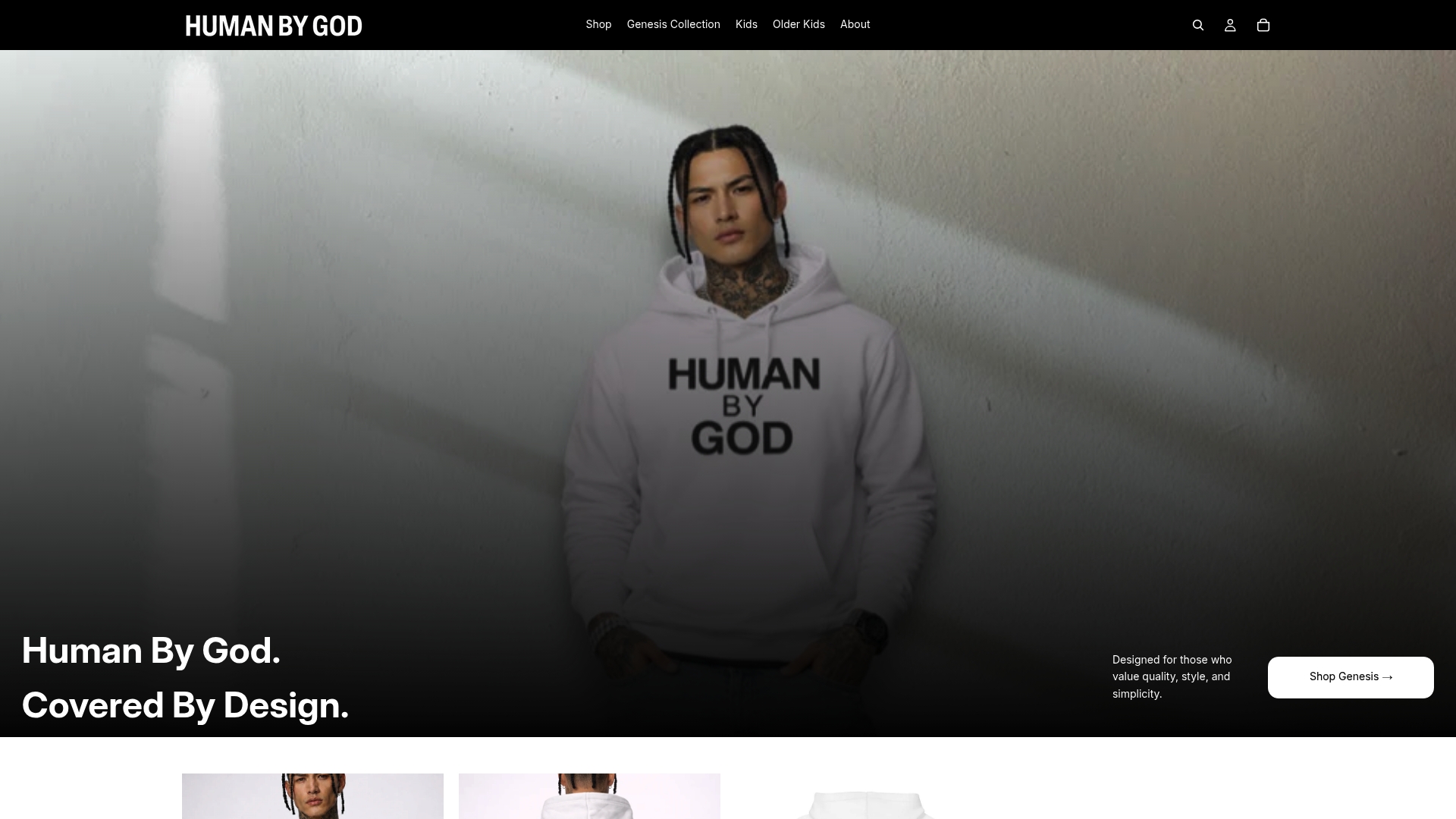
Human By God’s Genesis Collection is built on a single theological conviction: humans are made in God’s image, and that truth is worth wearing every day. The collection includes hoodies, t-shirts, and caps designed with quiet, color-coordinated typography that carries the weight of Genesis 1:26 without reducing it to decoration. Every piece is made for everyday wear, from the gym to the office, because the image of God does not clock out. The Genesis cap is a particular standout: minimal, premium, and unmistakably intentional. If you want faith apparel that respects the theology it references, this is where to start.
FAQ
What does Genesis 1:26 mean theologically?
Genesis 1:26 declares that humans are made in God’s image (tselem) and likeness (demuth), meaning they are His representatives and true reflections on earth. The verse also commissions humans to steward creation, linking identity directly to vocation.
What is the difference between “image” and “likeness” in Genesis 1:26?
Tselem means representation and demuth means genuine resemblance. Together they communicate that humans do not merely symbolize God but actually reflect His character and carry His delegated authority.
Why does Genesis 1:26 matter for wearable faith accessories?
The verse provides a foundation of dignity, vocation, and universal representation that translates into apparel without requiring slogans or clichés. Wearables rooted in vocation and dignity communicate more honestly than designs tied to isolated doctrinal claims.
Does Genesis 1:26 apply to all people equally?
Genesis 1:27 explicitly states that both male and female are made in God’s image, affirming universal dignity across genders. Any wearable design rooted in this text carries an inherently inclusive message.
What should wearable designs avoid when referencing Genesis 1:26?
Designs should avoid imagery that implies personal authority or dominance, since dominion is delegated stewardship, not autonomous power. Narrow doctrinal symbols tied to contested interpretations, like the “Us/Our” plural, also risk alienating diverse Christian audiences.