

There is a generation of Christians who are done with the graphic tee that shouts a slogan across the chest. Not because their faith is quieter. Because it runs deeper. The role of apparel in raising faith identity is not a new conversation, but the terms have shifted considerably. What was once a debate about modesty or church dress codes has become something far more personal: how do you wear who you are, without performing it? This article moves through the biblical roots of symbolic clothing, the psychology behind identity through garments, and the practical shape of modern faith fashion.
Table of Contents
- Key takeaways
- The biblical foundation of symbolic clothing
- How clothing shapes identity and community
- Subtlety as a design philosophy in faith fashion
- Practical choices for expressing faith through what you wear
- Navigating the real pitfalls in faith apparel
- My perspective on where faith and apparel actually meet
- What Human By God builds for this moment
- FAQ
Key takeaways
| Point | Details |
|---|---|
| Clothing has biblical weight | Scripture references clothing over 100 times as a symbol of divine mercy, dignity, and provision. |
| Apparel shapes how you feel | Enclothed cognition shows that what you wear affects your psychology, including your sense of faith and belonging. |
| Subtlety is the new statement | Modern faith apparel is moving toward hidden scripture, minimalist design, and internal details that speak to the wearer first. |
| Discernment matters more than rules | Choosing faith apparel should be a personal, prayerful practice, not a performance for others or a checklist to follow. |
| Quality is its own form of witness | Polished, well-made clothing can open spiritual conversations more naturally than explicit messaging ever could. |
The biblical foundation of symbolic clothing
Clothing appears over 100 times in Scripture as a metaphor for God’s mercy, provision, and identity. That number alone tells you this is not peripheral theology. From Genesis, where God clothes Adam and Eve after the fall, to Revelation’s imagery of white garments, fabric carries spiritual meaning throughout the biblical narrative. Clothing is how God demonstrates care. It is also how people mark moments of transformation.
The baptismal garment is one of the most direct examples. In early Christian tradition, new believers received white robes immediately after baptism as a physical marker of their new identity in Christ. The robe was not decoration. It was a statement of fact. You are now someone different. This is what clothes reflecting beliefs look like when taken seriously rather than treated casually.
Catholic writer Mary Harper has articulated this well. She describes how dressing with intention can become a spiritual practice, one that involves discernment about the message you intend to communicate. Her framing is not about rules. It is about awareness. What does this garment say? Who does it say it to? That question, posed before you get dressed in the morning, is more theologically serious than it sounds.
“God wants to cover us in robes of grace.” This image, drawn from Isaiah and expanded through the New Testament, positions clothing as an act of divine love. When you wear something that reflects that truth, you are participating in a very old and very sacred conversation.
Pro Tip: When a garment feels like it carries personal meaning rather than just a message, it is more likely to deepen your faith than perform it. Let the why behind what you wear matter as much as the what.
One important caution here: the goal is discernment, not scrupulosity. The history of religious attire significance is not without its problems. When dress codes become sources of anxiety or spiritual gatekeeping, they work against the very dignity clothing is meant to honor.
How clothing shapes identity and community
The science of how apparel shapes faith is more precise than most people expect. Enclothed cognition, a concept studied by psychologists Hajo Adam and Adam Galinsky, describes how the symbolic meaning of what you wear physically alters your cognitive state and behavior. When you wear something you associate with a specific identity, you begin to inhabit that identity more fully. That applies to faith.

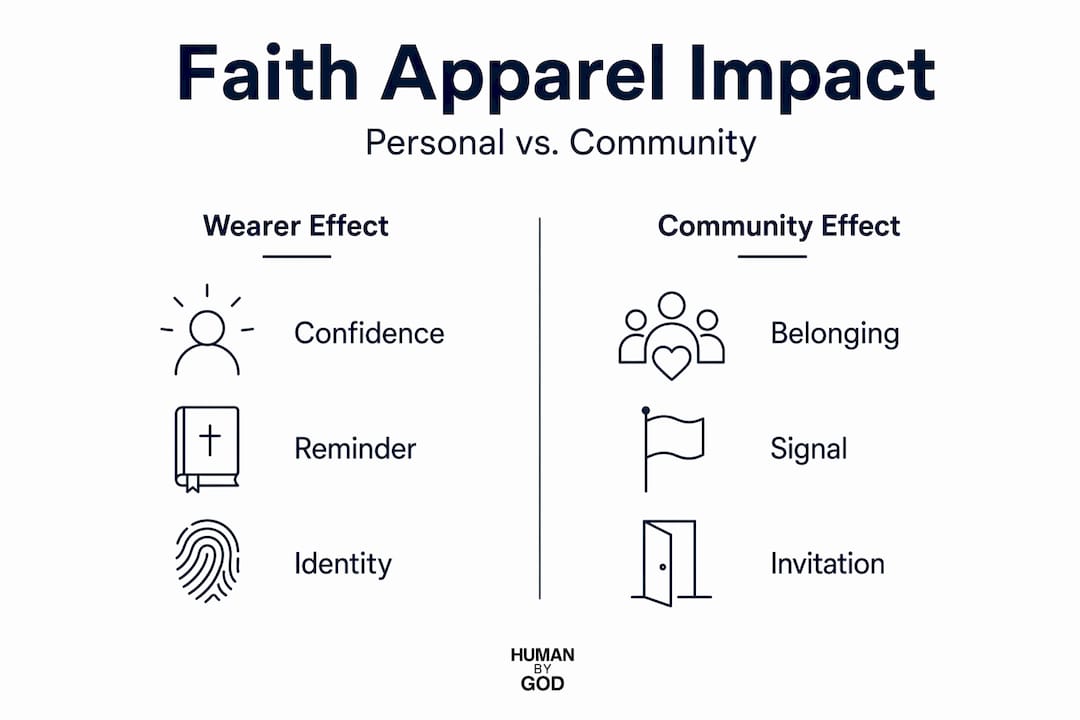
Faith-based clothing builds confidence and reinforces a sense of belonging through mechanisms that Social Identity Theory has mapped out for decades. You wear something that signals a shared value. Others who share that value recognize it. A conversation opens. A community strengthens. The garment does not create the faith, but it can anchor it.
Here is a comparison that illustrates how the intent behind faith apparel changes its function entirely:
| Apparel approach | Effect on wearer | Effect on community |
|---|---|---|
| Bold slogan tee | External declaration, often one-directional | Can signal in-group to believers, may alienate others |
| Subtle scripture detail | Private reminder, internal reinforcement | Invites curiosity and organic conversation |
| Generic premium streetwear worn with intention | Quiet confidence, no label required | Non-verbal integrity; faith expressed through presence |
The middle row is where a lot of young Christians find themselves right now. They want the reminder without the broadcast. They want clothing that bolsters identity and belonging without requiring everyone in the room to engage with it.
Pro Tip: If a piece of faith apparel makes you feel self-conscious rather than grounded, it is probably doing the wrong job. The best symbolic clothing strengthens your inner sense of who you are, not just what you want others to think.
There is also a necessary word of caution. Research shows that strict modesty messaging in church contexts correlates with higher rates of faith deconstruction, particularly among young women. When clothing rules replace personal conviction, the whole framework breaks down. The cultural apparel and religion relationship only works when it grows from the inside out.
Subtlety as a design philosophy in faith fashion
The shift happening in Christian apparel right now is not just stylistic. It reflects a deeper theological instinct. The rise of subtle faith expression in design is a direct response to a generation that values personal conviction over public declaration. What was once written across a chest is now stitched inside a collar or printed beneath the brim of a cap. Hidden. Intentional. Yours.
Born of Discipline, a brand that has been vocal about this design philosophy, places scriptures inside the crown of hats. The verse is invisible to everyone else. It is only for the person wearing it. That design decision carries real theological weight. It mirrors the biblical instruction to store God’s word in your heart, not just on your sleeve.
What modern faith fashion does well when executed with care:
- It prioritizes the wearer’s spiritual life over audience reception
- It invites conversation rather than making declarations
- It sits comfortably alongside premium contemporary brands without apology
- It treats quality and craft as part of the message itself
- It allows typography and detail to carry meaning without needing explanation
The fashion and faith identity conversation in 2026 is genuinely interesting because it is converging with broader cultural movements toward intentionality and restraint. The same sensibility that drives someone to buy a well-made, understated piece from a premium streetwear label is now driving how they think about faith expression. Clean. Considered. Not trying too hard.
Well-made Christian clothing functions as a non-verbal invitation. It signals something about who you are and how you carry yourself without making demands on the people around you. That is a form of interactive faith-sharing that tends to land far better than anything written in block letters across a hoodie.
Practical choices for expressing faith through what you wear
Knowing the theology and the psychology is useful. Applying it to your actual wardrobe requires a different kind of thinking. Start with discernment questions before you shop or get dressed.
- What do I want this garment to do for me? Is it a private reminder, a conversation starter, or simply something that aligns with how you see yourself? All three are valid, but knowing the answer shapes your choice.
- Does this reflect who I actually am, or who I think I should appear to be? There is a difference between clothes reflecting beliefs and clothes performing a version of those beliefs for an audience.
- Would I wear this in every context of my life? The best faith apparel is not reserved for Sundays. If it only makes sense in church, it may be more about cultural performance than personal identity.
- Does the quality of this piece honor the intention behind it? Cheap fabric with a Scripture verse is not a statement of faith. It is a product. The craft matters.
- How does this sit alongside everything else I own? Faith apparel works best when it integrates naturally into your existing wardrobe rather than existing as a separate, awkward category.
Pro Tip: Look at saints or biblical figures not for literal fashion inspiration, but for how they used their appearance as an extension of their calling. John the Baptist was distinctly himself. Esther dressed for the weight of a moment. Your wardrobe can be that considered.
You can find practical examples in everyday outfits for young Christians that balance personal conviction with contemporary style. The goal is not to dress like a walking theology lecture. It is to dress with the quiet confidence of someone who knows who they belong to.
Navigating the real pitfalls in faith apparel
Not everything about the intersection of clothing and faith is straightforward. There are real tensions worth naming. Research on modesty messaging and harmful outcomes shows that when dress becomes law rather than expression, it creates damage, not devotion. Legalistic approaches to Christian clothing have historically produced shame, exclusion, and a distorted sense of spiritual worth. That history deserves honesty.
A few things to watch for:
- Performative dressing. Wearing faith apparel primarily to signal virtue to others is a form of the same pride it often claims to reject. The most profound statements in faith apparel come from inward conviction, not outward display.
- Judgment of others’ choices. If your understanding of faith-based clothing leads you to evaluate the spiritual condition of someone else’s wardrobe, the framework has become legalistic regardless of how it was framed.
- Scrupulosity around specific pieces. Approaching dress choices with prayerful discernment is healthy. Anxious rule-following that turns every morning into a spiritual test is not.
The impact of clothing on faith should ultimately be freeing, not constricting. Mentorship and community support help here. Talking with people you trust about how you think about faith and appearance takes the pressure off any single garment to carry too much meaning.
My perspective on where faith and apparel actually meet
I’ve watched a lot of people get this wrong in both directions. There are those who dismiss faith apparel entirely as superficial, and there are those who use it as a substitute for the deeper work. Neither position holds up.
What I’ve come to believe is that the real power in how apparel shapes faith has almost nothing to do with visibility. The pieces that actually move people are the ones nobody else notices. A verse inside a collar. A quiet phrase on a garment worn to the gym at 6 a.m. Those private moments of seeing and being reminded. That is where clothing and faith actually intersect in a way that lasts.
I’ve also learned that quality is a form of intention. When you invest in something made well, you treat it differently. You wear it differently. The shift from church clothes to faith apparel is partly about this. It is a move from reserved-for-Sunday to woven-into-every-day. That is a more honest picture of what faith is supposed to look like in practice.
My honest take: stop worrying about whether your faith is visible enough to other people. Focus on whether it is visible to you. The garments that do the most work are the ones that remind you, privately, of who you are. Everything else is secondary.
— H
What Human By God builds for this moment
If this article has clarified anything, it is that the best faith apparel serves the wearer first. That is exactly what Human By God was built to do.

The Genesis Collection is designed around a single theological anchor: humans are made in the image of God. The apparel is premium and minimalist, with quiet typography drawn from Genesis 1:26 and the phrase “Always Seen. Always Covered.” Hoodies, caps with subtle scripture details, and tees designed for the gym, the office, and everywhere in between. No slogans. No clichés. Just well-made pieces that let your identity in Christ show up without announcing itself. Browse the collection and find the piece that feels like it was made for where you already are.
FAQ
What is the role of apparel in raising faith identity?
Apparel reinforces faith identity by serving as a daily, physical reminder of personal belief and spiritual belonging. When worn with intention, it can strengthen conviction, invite meaningful conversation, and anchor a sense of self rooted in faith.
Does faith apparel have to include visible Scripture or symbols?
No. Some of the most effective faith apparel places Scripture in hidden locations, like inside a collar or beneath a cap brim, creating a private reminder that speaks to the wearer rather than the audience. The impact of clothing on faith is often strongest when it is personal rather than public.
Can wearing faith-based clothing actually affect how you feel spiritually?
Yes. The psychological concept of enclothed cognition shows that the symbolic meaning of what you wear influences your mindset and behavior. Faith apparel builds confidence and reinforces a sense of identity, which directly supports spiritual life.
How do I avoid making faith apparel about performance rather than conviction?
Ask whether the garment serves you or your audience. If its meaning disappears when no one else can see it, it may be more about display than devotion. Choosing pieces with personal, quiet details tends to keep the focus inward.
Is there a wrong way to approach faith-based clothing?
The main risks are legalism and judgment. Research shows that strict modesty messaging can produce harmful psychological outcomes, and any framework that uses clothing to rank spiritual worth has lost the point entirely. Approach it with grace, curiosity, and the freedom that genuine faith allows.