

Most people assume streetwear is about hype. Limited drops, resale markets, brand logos worn as social currency. But how streetwear communicates belief runs much deeper than that surface reading. The hoodie you pull on before a morning walk, the cap worn to a quiet Sunday service, the tee that never needs explaining to someone who gets it — these choices carry meaning that no caption can fully translate. For young adults building a wardrobe around conviction, and for parents trying to understand what their kids are actually saying through what they wear, this is the conversation worth having.
Table of Contents
- Key Takeaways
- How streetwear communicates belief through history
- Symbolism in streetwear and its quiet visual codes
- The internal experience of intentional dressing
- Expressing belief in everyday and restricted environments
- Streetwear as a signal for community and belonging
- My perspective on streetwear as spiritual language
- Wear what you already know to be true
- FAQ
Key Takeaways
| Point | Details |
|---|---|
| Streetwear has deep roots | Clothing has historically carried political and spiritual meaning, and modern streetwear continues that tradition. |
| Symbols speak quietly | Subtle motifs and typography communicate belief without loud slogans, speaking to insiders while remaining understated to others. |
| Dressing can be intentional | Choosing garments that align with your values moves fashion from consumption to a conscious, embodied practice. |
| Context shapes expression | Tactical subtlety, like a single small symbol, lets wearers express belief respectfully in schools, offices, and public spaces. |
| Community forms through clothing | Shared visual codes in streetwear create belonging and signal identity to others who recognize the language. |
How streetwear communicates belief through history
Streetwear did not emerge from runways or luxury houses. It came from sidewalks, skate parks, and record stores. Those origins matter because they were never just about aesthetics. They were about saying something.

In the early years of hip-hop, clothing was a visual declaration of neighborhood, crew, and survival. Specific colors, logo placements, and silhouettes told a full story about where you stood, literally and culturally. Skate culture used graphics and worn fabrics to push against mainstream conformity. Both traditions treated clothing as political and social expression, a practice with roots stretching back centuries.
The point carries weight. There is no neutral wardrobe in any social context. What you wear signals hierarchy, allegiance, and resistance, whether you intend it to or not. The Civil Rights movement used neat, formal dress to communicate dignity and demand respect. Punk used ripped clothing and safety pins to reject institutional authority. Each choice was a statement made without a single spoken word.
Streetwear today continues that lineage. The hip-hop meets skate DNA in modern streetwear brands is not nostalgic cosplay. It is a living system of communication built on decades of cultural meaning. When a young person reaches for a specific piece, they are often reaching for an identity that has been rehearsed in communities long before them.
- Clothing has functioned as protest, spiritual declaration, and group membership for centuries.
- Skate and hip-hop communities used dress to define belonging outside mainstream systems.
- Contemporary streetwear inherits these expressive traditions even when wearers are unaware of the full history.
- Faith-based communities have long used dress as devotion, from liturgical garments to contemporary apparel.
Pro Tip: Before buying a piece because it looks good, ask what community built that aesthetic and what they were originally saying. The answer usually deepens your appreciation for what you are wearing.
Symbolism in streetwear and its quiet visual codes
Not everything gets said out loud. Some of the most powerful communication in streetwear happens through a single graphic, a word placed low on a chest, or a typeface chosen with precision. Sacred symbols in fashion today are worn less as doctrinal declarations and more as tools for personal inquiry and emotional expression.
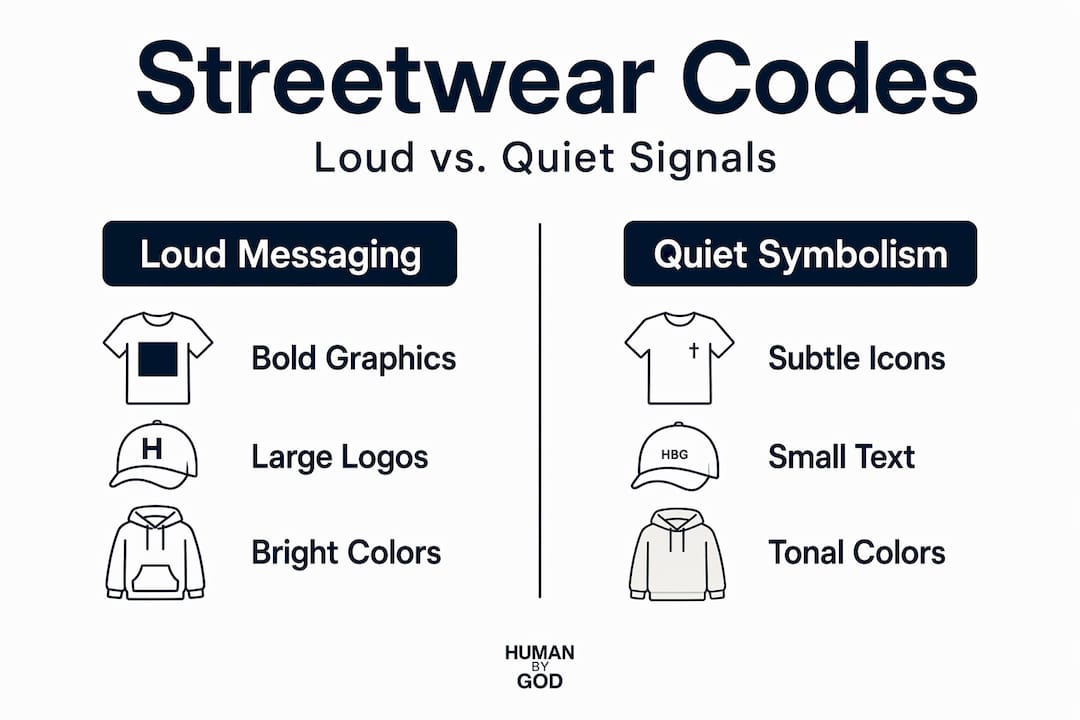
This is a meaningful distinction. A cross on a hoodie worn by someone who has thought deeply about what it represents reads differently than the same cross worn as trend decoration. The object is identical. The communication is not. The wearer knows the difference, and often, so does anyone else paying attention.
Typography carries its own weight in this space. A Scripture reference rendered in quiet, color-coordinated type against a muted fabric communicates restraint, intentionality, and confidence, all at once. It does not demand attention. It rewards it. That is exactly how typography in faith apparel functions at its best: not as a billboard, but as a conversation starter available only to those who lean in.
Here is a useful comparison of how loud versus quiet streetwear expression lands in different contexts:
| Approach | Loud messaging | Quiet symbolism |
|---|---|---|
| Communication style | Broadcasts to everyone | Speaks to those who recognize it |
| Audience response | Often polarizing | Creates private recognition and connection |
| Wearability | Contextually limited | Works across gym, office, and everyday life |
| Perceived intent | Can feel performative | Reads as genuine and considered |
| Example | Full-front graphic slogan | Small embroidered word or tonal Scripture reference |
Merch compresses brand values and cultural cues into instantly legible signals among insiders. When someone sees a piece they recognize, it functions as a kind of silent introduction. You already know something about each other before a word is exchanged. That is the real power of symbolism in streetwear, and it explains why the most resonant pieces rarely need to be loud.
The internal experience of intentional dressing
There is a version of wearing belief-based clothing that is purely performative. And then there is something else entirely. True belief-based dressing involves somatic alignment, selecting garments that make the wearer feel internally aligned rather than only signal externally.
Put simply: there is a difference between wearing something because it looks right and wearing something because it is right. One is about impression management. The other is about integrity. When those two things align, clothing stops being consumption and becomes something closer to practice.
Conscious dressing with real awareness turns fashion from a habit into a devoted act connected to values. For someone whose faith shapes how they see themselves and others, the clothes they choose can function as a daily, embodied reminder of that identity. Not a performance for the outside world. A quiet signal to themselves.
This matters especially for young adults constructing a sense of self in real time. A wardrobe built around belief does not need to announce itself. It just needs to be honest.
Clothing is not what you say about yourself. It is what you already know to be true, made visible.
Pro Tip: When building a wardrobe of belief, prioritize pieces you would still wear five years from now. If something feels hype-driven today, it will feel hollow next season. Pieces that hold meaning tend to hold their shape in your closet too.
There is also a temporal dimension to this. Authentic identity builds with distance and integration, not with immediate consumption. A piece that meant something when you bought it means more when it has been through real life with you. Fading, washing, layering — these are not just aesthetic processes. They are how a garment becomes yours.
Expressing belief in everyday and restricted environments
Not every setting welcomes visible belief expression. Schools have dress codes. Workplaces have unwritten rules. Public spaces come with their own social contracts. The practical question is how to express what you believe without creating friction that drowns out the message entirely.
A three-rule framework recommended for schools and workplaces offers a grounded starting point:
- Keep the overall look neat and considered. A well-put-together outfit signals respect for the environment, which creates more room for the small belief signal within it.
- Avoid graphics that could be read as offensive, divisive, or confrontational. The goal is expression, not provocation.
- Choose one small, meaningful symbol rather than multiple competing messages. A single embroidered word, a subtle logo, or a tonal graphic does more in a restricted context than a full-front statement piece.
The restraint in this approach is not compromise. It is strategy. When belief is expressed through quality, intentionality, and quiet confidence, it tends to generate curiosity rather than defensiveness. People ask about the piece. That is a conversation you choose to have. That is entirely different from a reaction forced on everyone in the room.
For parents navigating this with teenagers, the framework offers a useful structure. It is not about suppressing expression. It is about teaching young people how to communicate with precision, which is a skill that extends well beyond what they wear.
Streetwear as a signal for community and belonging
One of the most underappreciated functions of streetwear is its capacity to find people for you. Not loudly. Not through announcement. Through the quiet recognition that happens when two people wearing the right things encounter each other and know.
Over 50% of youth fashion subculture engagement reflects emotional allegiance to shared values and communities rather than traditional status markers. The shift is significant. Streetwear stopped being about showing what you could afford and started being about showing who you are and what you stand alongside.
This “if you know, you know” quality is what makes faith-rooted streetwear particularly powerful:
- A subtle Scripture reference on a cap signals something specific to someone who carries that same text.
- Quiet, restrained aesthetics communicate that the wearer takes their faith seriously without needing external validation.
- Shared visual language creates cultural memory within faith communities, building a collective identity that persists over time.
- For young people in secular environments, belief-based streetwear creates a portable, daily connection to something larger than the immediate context.
This is why faith apparel replacing church clothes is not a watering down of religious expression. It is an adaptation of it. The conversation moved outside the building, into the places where people actually live.
My perspective on streetwear as spiritual language
I’ve spent a long time sitting with the question of what clothes actually say. And the thing I keep coming back to is this: the most powerful pieces are the ones that do not try to convince anyone of anything.
Fashion’s current engagement with spiritual symbols reflects a search for emotional gravity, not trend cycling. People are reaching for clothing that carries weight because so much of modern life feels weightless. That impulse is honest, and it deserves a honest response from the brands building for it.
What I’ve learned from watching how people actually wear belief-based clothing is that the pieces with the longest life are the ones with the most restraint. A hoodie that asks nothing of the room but quietly holds something true. A cap worn to the grocery store that carries a verse you came back to in a hard season. These are not marketing objects. They are personal artifacts.
The mistake I see most often is confusing visibility with impact. Louder is not more faithful. Quieter is often more true. And when a piece of clothing is genuinely aligned with what the wearer believes, it does not need to perform. It just needs to be present.
That is what I’d want anyone exploring this space to understand. The goal is not to be seen believing. The goal is to be so settled in what you believe that it shows up naturally, in everything, including what you wear.
— H
Wear what you already know to be true

Human By God was built on exactly this principle. Every piece in the collection is designed to carry meaning without announcing it. The Genesis Collection uses quiet, color-coordinated typography rooted in Genesis 1:26, “Always Seen. Always Covered.” to create wearables that feel modern and grounded at the same time. No clichés, no performance. Just clothing that holds a conviction you already carry.
If you are looking for pieces that work across the gym, the office, and Sunday morning without changing what they say about you, the Genesis Collection is a strong place to start. The embroidered faith hoodie and the full range of adult hoodies are built for everyday wear, elevated quality, and the kind of staying power that only comes from meaning it.
FAQ
What does streetwear actually communicate beyond style?
Streetwear communicates group identity, spiritual belief, political allegiance, and personal values through symbols, typography, and visual codes that insiders recognize without explanation.
How do subtle symbols in streetwear express belief?
Quiet motifs like tonal Scripture references, minimalist logos, and restrained typography speak to shared belief without broadcasting it, functioning as private signals for those who already understand the language.
Can you express faith through clothing at school or work?
Yes. A three-rule framework, keeping the look neat, avoiding provocative graphics, and using a single small symbol, allows meaningful faith expression while respecting dress codes and social context.
Why does intentional dressing matter for faith expression?
Somatic alignment means choosing clothing that reflects your internal values, not just your external image. When a piece genuinely aligns with belief, it carries authority that performative dressing never does.
How does streetwear help build community around shared values?
Shared visual codes in streetwear create recognition between people who hold the same beliefs, enabling quiet belonging without the need for formal introduction or public declaration.